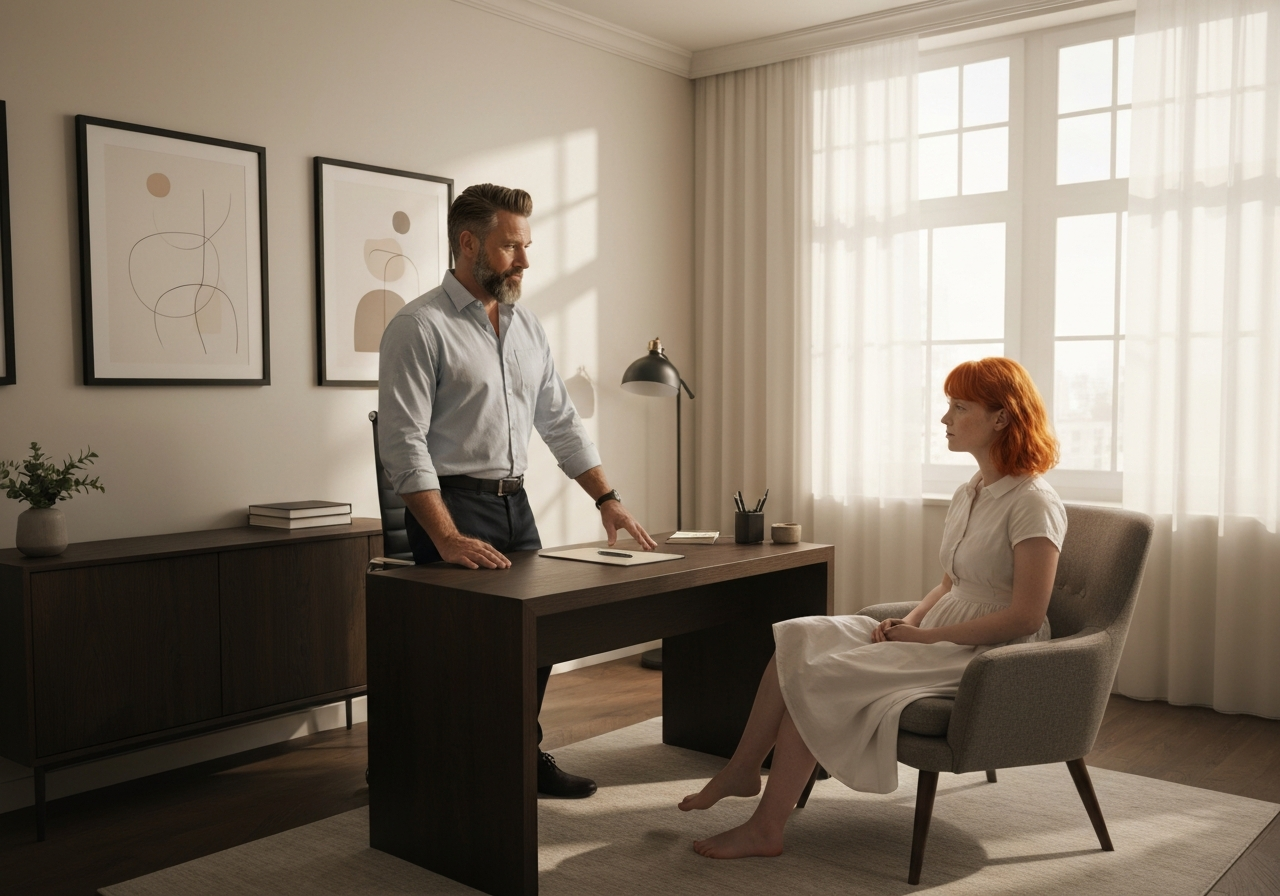
First Psychiatrist Visit

How to Prepare for Your First Psychiatric Appointment

Making the decision to seek help for your mental health is a brave and significant step. As a psychiatrist, I see patients every day who walk through my doors feeling a mix of hope and nervousness. It is completely normal to feel a little anxious about your first visit. You might not know what to say, what will happen, or how it differs from a regular doctor’s visit. My goal today is to demystify this process for you. When you prepare well, you empower yourself. You turn the unknown into a structured plan. Whether you are coming in for general anxiety, depression, or simply to get a better understanding of your mental well-being, preparation ensures we can make the most of our time together. If you have booked a Psychiatric Consultation Beverly Hills, or are planning to, this guide will help you feel ready, confident, and heard. Understanding the Goal


Read More »
Mens Mental Health

Men’s Mental Health: Breaking the Stigma of Seeking Help

We have all heard phrases like “man up” or “boys don’t cry” at some point in our lives. From a young age, many of us are taught that showing emotion is a sign of weakness. We learn to bottle up our feelings, push through the pain, and handle our problems on our own. But as a doctor who has spent years working with men, I can tell you that this mindset is not just outdated; it is dangerous. Mental health is just as real and important as physical health. If you broke your leg, you wouldn’t try to walk it off. You would go to a doctor. Yet, when it comes to our minds, we often hesitate. We worry about what others will think or fear that asking for help means we have failed. Today, I want to talk about why breaking this stigma is crucial and how seeking support

Read More »
Teen Substance Abuse

Substance Use vs. Experimentation in Beverly Hills Teens

Living and working in Beverly Hills, I often sit across from parents who are holding their breath. They love their children deeply, and they provide them with every possible opportunity, from top-tier education to enriching extracurricular activities. Yet, when they find a vape pen in a backpack or smell alcohol on their teenager’s breath after a party, that world of opportunity suddenly feels very fragile. The question in their eyes is always the same: “Is this just a phase, or are we in trouble?” As a medical professional in this community, I understand that the line between teenage experimentation and actual substance use issues can feel blurry. It is frightening to navigate, especially given the unique pressures our adolescents face in high-achieving environments. My goal is to help you understand what is happening in your teen’s brain, how to spot the difference between curiosity and a developing problem, and how

Read More »
Psychosomatic Symptoms

Understanding Psychosomatic Pain: When Stress Hurts Physically

Have you ever noticed that your stomach starts to turn in knots right before a big presentation? or maybe you develop a pounding headache after a long, frustrating argument with a partner? If so, you have experienced the undeniable link between your emotions and your physical body. As a medical professional, I see this every day. It is fascinating, but for many people, it can also be confusing and painful. I am Dr. Peyman Tashkandi, and today I want to talk to you about psychosomatic pain. This is a topic that is often misunderstood. Many people hear the word “psychosomatic” and think it means “fake” or “imaginary.” I want to be very clear right from the start: the pain is absolutely real. It is not something you are making up. However, the root cause isn’t a broken bone or a virus; it is the complex way your brain handles stress

Read More »
Emotional Dysregulation

Dealing with Tantrums vs. Emotional Dysregulation

As Dr. Peyman Tashkandi, I have sat across from countless parents who look completely exhausted. They love their children deeply, but they are tired of the screaming, the kicking, and the feeling of walking on eggshells in their own homes. Usually, the conversation starts the same way. A parent will say, “My child throws the worst tantrums. I’ve tried time-outs, I’ve tried taking away iPads, but nothing works. It just gets worse.” I always listen carefully, but then I have to ask the most important question of the intake process: “Are we looking at a tantrum, or are we looking at emotional dysregulation?” To the untrained eye, a child screaming on the floor looks the same regardless of the cause. However, understanding the difference between a willful tantrum and genuine emotional dysregulation is the key to unlocking peace in your home. If we treat a meltdown like a behavioral problem,

Read More »
Psychiatric Second Opinion

Second Opinion in Psychiatry: When to Seek One?

Navigating the world of mental health can sometimes feel like trying to read a map in the dark. You know where you want to go—a place of stability, peace, and happiness—but the route isn’t always clear. As a psychiatrist, I have walked this path with countless individuals. I know that finding the right diagnosis and the perfect treatment plan is often a journey rather than a single event. It requires patience, open communication, and sometimes, a fresh pair of eyes. One of the most common questions I hear in my practice is, “Is it okay if I talk to someone else?” My answer is always a resounding “Yes.” Seeking a second opinion is not about betrayal or mistrust; it is about advocacy. It is about making sure that you have the best possible information to manage your health. Today, I want to walk you through exactly when and why you

Read More »
TikTok Mental Health Trends

The Danger of Self-Diagnosing Mental Illness on TikTok

We have all been there. It’s late at night, and you are lying in bed, the blue light of your phone illuminating the room. You tell yourself, “Just five more minutes,” but an hour later, you are still scrolling through your “For You” page on TikTok. Suddenly, a video pops up. A creator looks directly into the camera and lists five specific behaviors: spacing out during conversations, tapping your foot constantly, forgetting where you put your keys, feeling overwhelmed by loud noises, and procrastinating until the last minute. The caption reads: “Signs you might have high-functioning ADHD.” You pause. You do every single one of those things. In fact, you did three of them today. You click on the comments, and thousands of people are saying, “Wait, this is me,” or “I thought everyone did this!” Suddenly, a sense of relief washes over you. Finally, there is a name for

Read More »
Separation Anxiety Disorder

Separation Anxiety in Older Children and Teens

In my practice, I frequently meet parents who are confused and worried. They often tell me, “Dr. Tashkandi, my child was fine in elementary school, but now that they are in high school, they panic whenever I leave the house.” It is a common misconception that separation anxiety is strictly a toddler issue. While we expect tears on the first day of kindergarten, we are often blindsided when a 14-year-old refuses to go to a sleepover or text messages us fifty times a day. I want to reassure you right from the start: what you are observing is real, it is valid, and most importantly, it is treatable. Separation Anxiety Disorder (SAD) can persist into or re-emerge during adolescence. The biological and social changes happening during the teenage years are intense, and sometimes, the brain reacts by clinging to safety—which usually means clinging to parents. In this guide, I will

Read More »
Bipolar and Creativity

Managing Bipolar Disorder Without Losing Your Creativity

As a psychiatrist, one of the most common fears I hear when a new patient sits in my chair isn’t about the diagnosis itself. It isn’t even about the stigma. The deepest, most heartfelt worry comes from my patients who are artists, writers, musicians, and entrepreneurs. They look at me and ask, “Dr. Tashkandi, if I take medication, will I lose my spark? Will I stop being creative?” I understand this fear completely. For centuries, we have romanticized the idea of the “tortured artist.” We look at figures like Vincent van Gogh, Ernest Hemingway, or Sylvia Plath, and we assume that their mental health struggles were the fuel for their genius. It is easy to believe that the high energy of mania is necessary for creating a masterpiece. However, I want to tell you something that I have seen proven time and time again in my practice: You do not

Read More »
ADHD vs Learning Disability

Identifying Learning Disabilities vs. ADHD in School-Aged Kids

As a professional in the field of psychology, I have sat across from countless concerned parents who all share a similar story. They tell me their child is bright, curious, and capable, yet for some reason, they are hitting a wall at school. The report cards come back with comments like “needs to focus more” or “not working to potential.” At home, homework time turns into a nightly battle of tears and frustration. As a parent, you know something is getting in the way, but you can’t quite put your finger on it. Is it an attention issue? Is it a learning gap? Or is it both? One of the most common puzzles I help families solve is distinguishing between Attention-Deficit/Hyperactivity Disorder (ADHD) and Learning Disabilities (LDs). While they are distinct conditions, they often look remarkably similar in a classroom setting. Furthermore, they frequently travel together. Understanding the nuance between

Read More »
Depression Treatment Options

Medication vs. Therapy for Depression: Which is Right for You?

Deciding to seek help for your mental health is one of the bravest steps you can take. However, once you make that choice, you are often met with a confusing fork in the road. Should you sit on a couch and talk about your feelings, or should you take a pill to balance your brain chemistry? This is the classic debate of medication versus therapy. As a Depression Psychiatrist in Beverly Hills, I face this question almost every day. My patients come to me feeling overwhelmed, tired, and unsure of which path will lead them back to happiness. The truth is, there isn’t a single right answer that applies to everyone. Your mental health journey is as unique as your fingerprint. In this guide, I want to walk you through the benefits and drawbacks of both options. My goal is to help you understand what is happening inside your brain

Read More »
Family Therapy for Teens

The Benefits of Family Therapy for Adolescent Behavioral Issues

As a mental health professional who has spent years working with families, I have seen firsthand how challenging the teenage years can be. One day, your child is asking you for help with their homework, and the next, it feels like you are living with a stranger who speaks a different language. If you are reading this, you might be feeling frustrated, worried, or even a little hopeless about the changes you see in your adolescent. I want you to know that you are not alone. Adolescent behavioral issues are one of the most common reasons parents reach out to my practice. Whether it is sudden aggression, withdrawal from family activities, a drop in grades, or risky behaviors, these actions are often a cry for help. As Dr. Peyman Tashkandi, I approach these situations with compassion and science. I believe that the most effective way to help a struggling teen

Read More »
Gender Dysphoria Support

Gender Dysphoria: Supporting Your Child’s Journey

As a mental health professional, I have sat across from many parents who love their children deeply but feel completely lost when the topic of gender identity arises. If your child has told you they are questioning their gender, or if you have noticed signs of gender dysphoria, it is normal to feel a mix of emotions. You might feel fear, confusion, or even grief for the future you had imagined for them. I want you to know that these feelings are valid. However, the most important thing right now is how we move forward to ensure your child feels safe, seen, and supported. My name is Dr. Peyman Tashkandi, and in my practice, I have witnessed the incredible transformation that happens when a child with gender dysphoria receives the right support. Navigating this journey requires patience, education, and often, professional guidance. In this guide, I want to walk you

Read More »
Trauma Informed Psychiatrist

Trauma-Informed Care: Why It Matters for Your Treatment

Welcome. If you are reading this, you are likely taking the first, brave step toward understanding your own mental health or helping a loved one navigate theirs. I am Dr. Peyman Tashkandi, and today I want to talk to you about a concept that is absolutely central to my practice and philosophy: Trauma-Informed Care. In the world of mental health, we often hear about diagnoses, medications, and symptoms. While these are important, they don’t always tell the whole story. To truly heal, we have to look at the context of your life. We have to look at what you have been through. This is where Trauma-Informed Care (TIC) comes in. It is not just a buzzword; it is a fundamental shift in how we approach treatment, shifting the focus from “What is wrong with you?” to “What happened to you?” As a Trauma Psychiatrist Beverly Hills residents rely on, I

Read More »
OCD Symptoms in Kids

OCD in Children: It’s Not Just About Being Tidy

As a medical professional, I often hear parents say things like, “My child is so organized, they must have a little OCD.” It is usually said with a chuckle, referring to a color-coded bookshelf or a perfectly made bed. While I understand that these comments are rarely meant to be harmful, they highlight a massive misunderstanding about what Obsessive-Compulsive Disorder (OCD) actually looks like in children. There is a prevailing myth that OCD is simply about being tidy, clean, or particular about details. The reality, however, is far more complex and often much more distressing for the child involved. In my practice, I have seen that OCD is rarely about a love for cleanliness; it is about a search for certainty and safety in a world that feels scary. Today, I want to pull back the curtain on this condition to help parents, teachers, and caregivers understand what is really

Read More »
Child Grief Counseling

Helping a Child Cope with Grief and Loss

As Dr. Peyman Tashkandi, I have witnessed the incredible resilience of the human spirit, even in our youngest patients. However, I also know that navigating the murky waters of loss with a child is one of the most challenging tasks a parent or guardian can face. When a family experiences a death, the ground feels unsteady. You are managing your own sorrow while trying to be the anchor for your child. It is a balancing act that requires patience, honesty, and a lot of love. My goal here is to guide you through this journey. We will look at how children process loss differently than adults, practical ways to support them, and when to call in extra support. While the pain of loss is inevitable, traumatic grief is not. With the right tools, we can help children integrate this loss into their lives in a healthy, meaningful way. Understanding How

Read More »
Postpartum Depression Help

Postpartum Depression: It’s More Than Just the Baby Blues

Bringing a new life into the world is often described as one of the most magical experiences a person can have. There is the anticipation, the preparation, and finally, that moment you hold your baby for the first time. However, for many new mothers, this transition isn’t just filled with joy and excitement. It can also bring a wave of overwhelming emotions, anxiety, and sadness. As a mental health professional, I want to tell you right away: if you aren’t feeling that “glow” everyone talks about, you are not broken, and you are certainly not alone. In my practice, I meet many brilliant, loving parents who feel guilty because they are struggling. They often wonder if they are just tired or if something more serious is going on. Today, I want to walk you through the differences between the “Baby Blues” and Postpartum Depression (PPD). Understanding this distinction is the

Read More »
Executive Burnout Treatment

Burnout Recovery for Executives and Entrepreneurs

You built the company. You led the team through the merger. You stayed up late to ensure the quarterly goals were met. For years, you have thrived on adrenaline, caffeine, and the sheer will to succeed. But lately, something feels different. It isn’t just tiredness anymore. It feels like your internal battery won’t hold a charge, no matter how long you sleep. If you are reading this, you might be wondering if you have lost your edge. Let me assure you, you haven’t. You are likely experiencing a physiological and psychological state known as executive burnout. As a doctor, I see high-performers hit this wall frequently. The good news is that recovery is not only possible, but it can also lead to a more sustainable way of leading your life and business. In my practice, I have helped countless leaders navigate this difficult terrain. I want to share the medical

Read More »
Oppositional Defiant Disorder

Understanding ODD (Oppositional Defiant Disorder) in Children

As a psychiatrist, I often sit with parents who feel completely exhausted. They describe a home life that feels like a battlefield, where simple requests turn into hour-long arguments and daily routines end in tears. If you are reading this, you might be feeling that same exhaustion. You might be wondering if your child’s behavior is just a phase, or if it is something more significant. It is important to know that you are not alone, and there is a name for what you might be experiencing: Oppositional Defiant Disorder, or ODD. In my practice, I emphasize that understanding the “why” behind a child’s behavior is the first step toward healing. ODD is a behavioral condition that affects how a child interacts with authority figures, processes emotions, and handles frustration. It is more than just being “difficult” or “strong-willed.” It is a consistent pattern that can disrupt family life and

Read More »
Telepsychiatry California

Telepsychiatry in California: Is Online Care as Effective?

Living in California offers an incredible lifestyle, from the stunning coastlines to the vibrant culture of our cities. However, the fast-paced nature of life here, combined with our infamous traffic, can make prioritizing mental health a logistical challenge. In recent years, I have witnessed a massive shift in how people access medical care. The traditional image of a therapy session—lying on a couch in a quiet office—is evolving. Today, healing often happens through a screen. As a mental health professional, one of the most common questions I hear is whether telepsychiatry is actually as effective as seeing a doctor in person. It is a valid concern. When you are sharing your deepest thoughts and vulnerabilities, you want to ensure you are receiving the highest quality care. In this post, I want to explore the reality of online mental health care in California, look at the data, and share my perspective

Read More »